Skip to content
  • Home
  • People
  • Education
    • Adolescent Development Lab
    • Structural Competency
    • Health Equity / Translational Social Science Research Theme
  • Resources & Media
    • Historical Archives
    • Webinars & Talks
    • Announcements
    • Exchange Visitor (J-1) Program
  • Social
    • YouTube
      • HETSS/Rangell
      • Center for Social Medicine
    • Twitter
  • MSTP
  • Home
  • People
  • Education
    • Adolescent Development Lab
    • Structural Competency
    • Health Equity / Translational Social Science Research Theme
  • Resources & Media
    • Historical Archives
    • Webinars & Talks
    • Announcements
    • Exchange Visitor (J-1) Program
  • Social
    • YouTube
      • HETSS/Rangell
      • Center for Social Medicine
    • Twitter
  • MSTP

Announcements

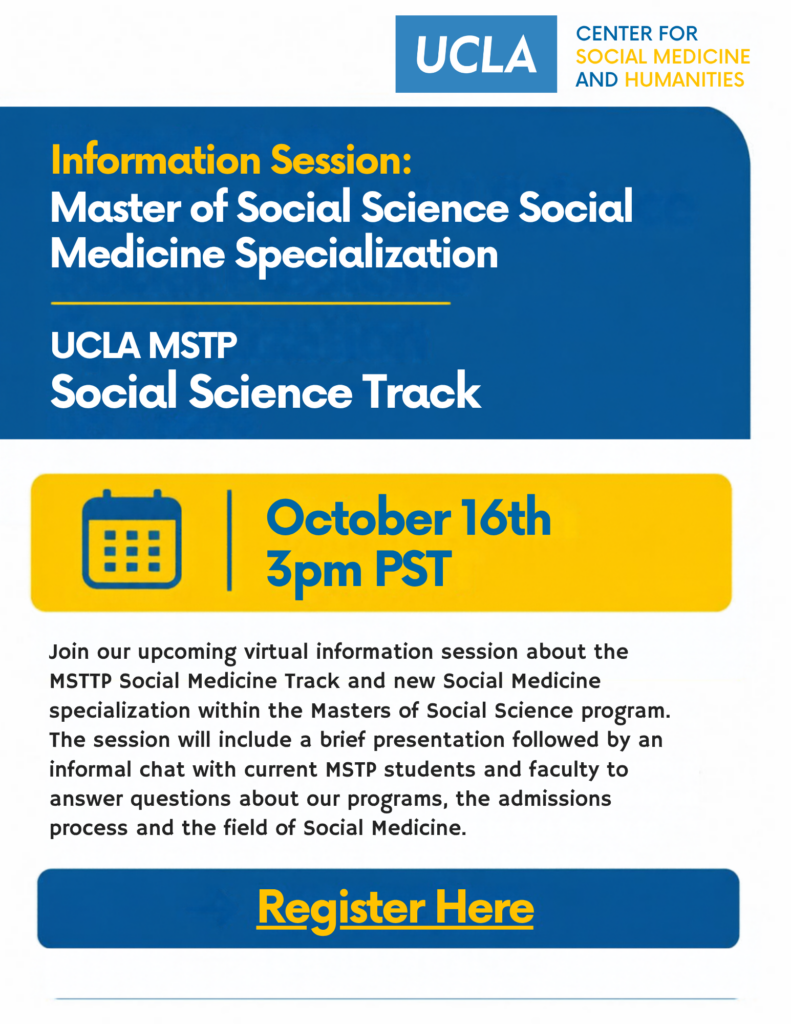
A blue, yellow, and white poster in a blue text bubble writes "Information Session: Master of Social Science Social Medicine Specialization UCLAMSTP Social Science Track." There is a yellow box with a calendar symbol next to it writes "October 16th 3pm PST." Below writes "Join our upcoming virtual information session about the MSTTP Social Medicine Track and new Social Medicine specialization within the Masters of Social Science program. The session will include a brief presentation followed by an informal chat with current MSTP students and faculty to answer questions about our programs, the admissions process and the field of Social Medicine." Underneath in a blue box says "Register Here"
Upcoming Event
Learn More »
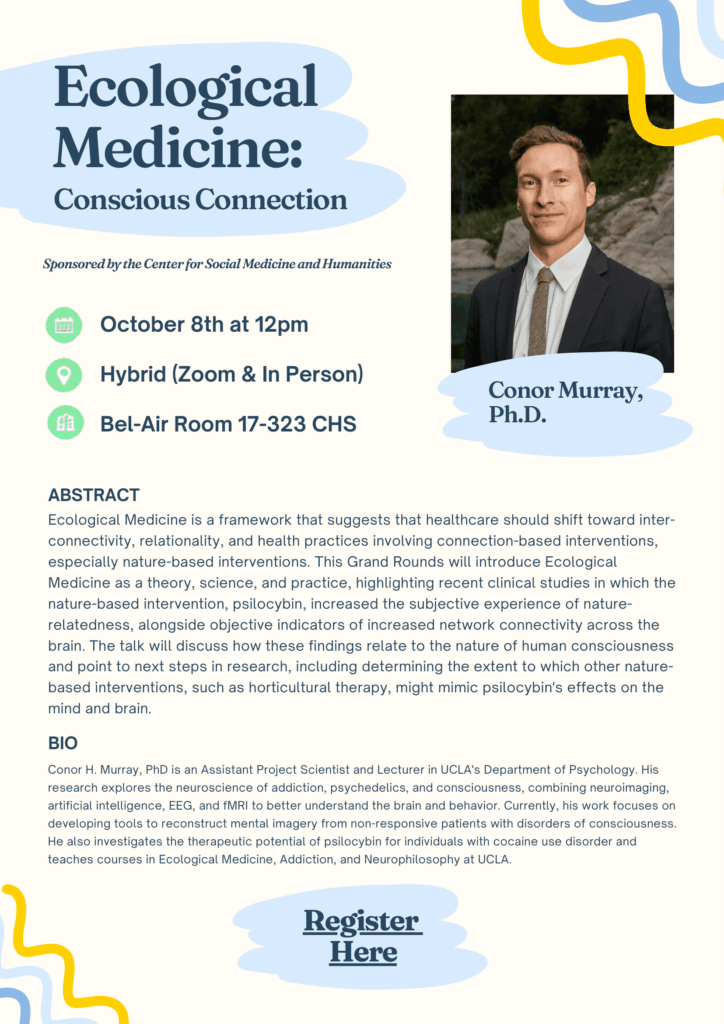
A light yellow poster with blue accents writes "Ecological Medicine: Conscious Connection Sponsored by the Center for Social Medicine and Humanities" is written at the top in dark blue. Under details "October 8th at 12pm Hybrid (Zoom & In Person) Bel-Air Room 17-323 CHS." Next to it is a picture of Connor Murray, a middle age white man with short dark brown hair slick back in a black suit smiles at the camera" under the picture writes "Connor Murray Ph.D." Below lists the abstract "Ecological Medicine is a framework that suggests that healthcare should shift toward interconnectivity, relationality, and health practices involving connection-based interventions, especially nature-based interventions. This Grand Rounds will introduce Ecological Medicine as a theory, science, and practice, highlighting recent clinical studies in which the nature-based intervention, psilocybin, increased the subjective experience of naturerelatedness, alongside objective indicators of increased network connectivity across the brain. The talk will discuss how these findings relate to the nature of human consciousness and point to next steps in research, including determining the extent to which other naturebased interventions, such as horticultural therapy, might mimic psilocybin's effects on the mind and brain." Below is Murray's bio "Conor H. Murray, PhD is an Assistant Project Scientist and Lecturer in UCLA's Department of Psychology. His research explores the neuroscience of addiction, psychedelics, and consciousness, combining neuroimaging, artificial intelligence, EEG, and fMRI to better understand the brain and behavior. Currently, his work focuses on developing tools to reconstruct mental imagery from non-responsive patients with disorders of consciousness. He also investigates the therapeutic potential of psilocybin for individuals with cocaine use disorder and teaches courses in Ecological Medicine, Addiction, and Neurophilosophy at UCLA." Below the bio it states "Register here" underlined
Upcoming Talk
Learn More »
Previous Talks
Learn More »
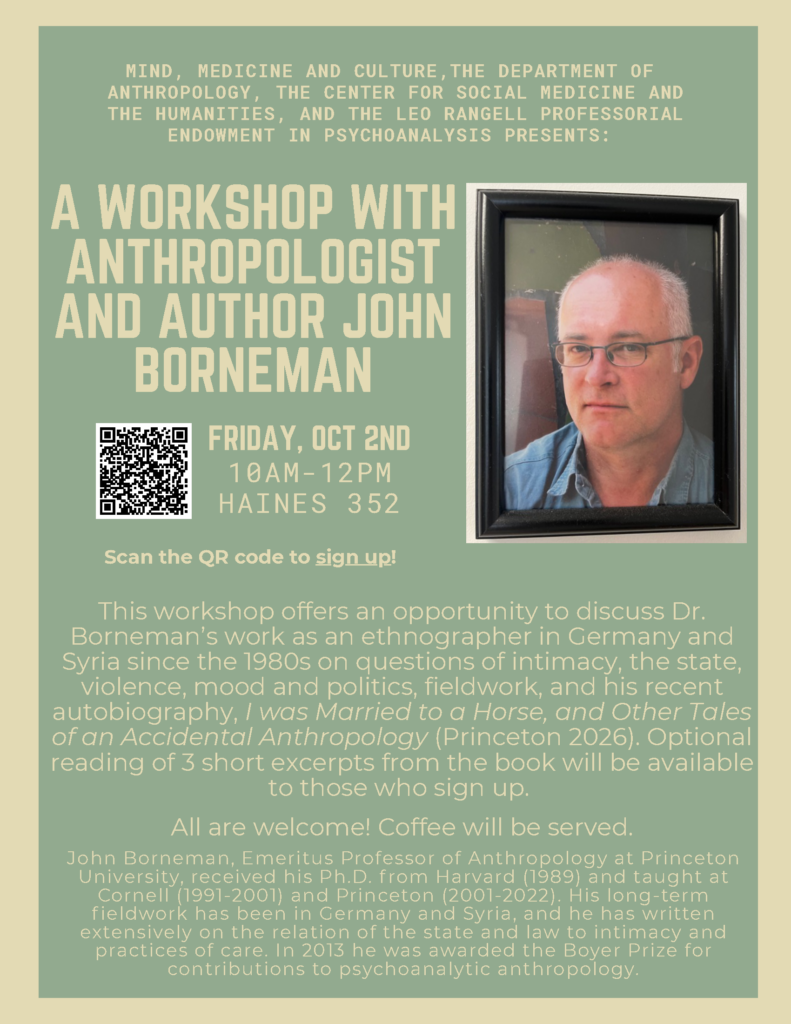
Green and yellow poster labeled "MIND, MEDICINE AND CULTURE,THE DEPARTMENT OF ANTHROPOLOGY, THE CENTER FOR SOCIAL MEDICINE AND THE HUMANITIES, AND THE LEO RANGELL PROFESSORIAL ENDOWMENT IN PSYCHOANALYSIS PRESENTS: A WORKSHOP WITH ANTHROPOLOGIST AND AUTHOR JOHN BORNEMAN" underneath is a QR code to sign up for the workshop. To the right of the QR code states "FRIDAY, OCT 2ND 10AM-12PM HAINES 352 Scan the QR code to sign up!" To the right of the text is a framed photo of Borneman looking stoically into the camera. Below in yellow writes "This workshop offers an opportunity to discuss Dr. Borneman’s work as an ethnographer in Germany and Syria since the 1980s on questions of intimacy, the state, violence, mood and politics, fieldwork, and his recent autobiography, I was Married to a Horse, and Other Tales of an Accidental Anthropology (Princeton 2026). Optional reading of 3 short excerpts from the book will be available to those who sign up. All are welcome! Coffee will be served. MIND, MEDICINE AND CULTURE,THE DEPARTMENT OF ANTHROPOLOGY, THE CENTER FOR SOCIAL MEDICINE AND THE HUMANITIES, AND THE LEO RANGELL PROFESSORIAL ENDOWMENT IN PSYCHOANALYSIS PRESENTS: FRIDAY, OCT 2ND 10AM-12PM HAINES 352 John Borneman, Emeritus Professor of Anthropology at Princeton University, received his Ph.D. f rom Harvard (1989) and taught at Cornell (1991-2001) and Princeton (2001-2022). His long-term f ieldwork has been in Germany and Syria, and he has written extensively on the relation of the state and law to intimacy and practices of care. In 2013 he was awarded the Boyer Prize for contributions to psychoanalytic anthropology."
Previous Event
Learn More »
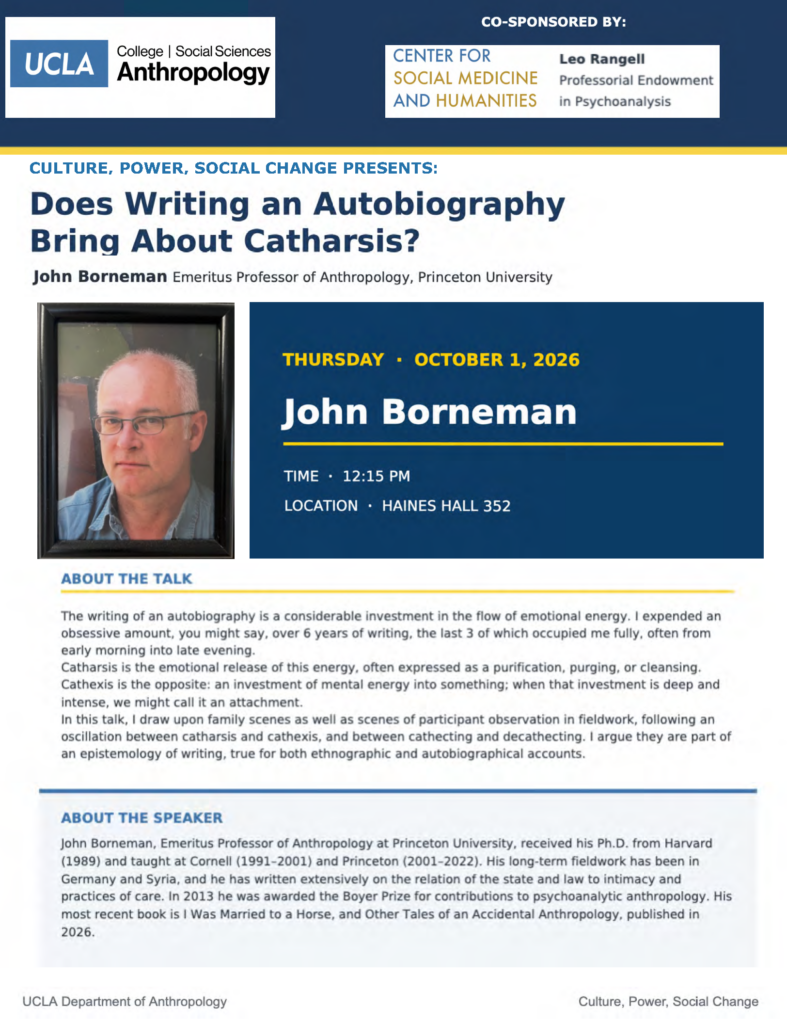
The top of the poster writes "UCLA College | Social Sciences Anthropology Co-Sponsored by Center for Social Medicine and Humanities Leo Rangell Professional Endowment in Psychoanalysis." Below the poster advertises "Does Writing an Autobiography Bring About Catharsis? John Borneman Emeritus Professor of Anthropology, Princeton University." The right dark blue box writes "THURSDAY • OCTOBER 1, 2026 John Borneman TIME • 12:15 PM LOCATION • HAINES HALL 352." The box sits next to a framed picture of Borneman, a white person with white hair, glasses, and a collared blue shirt staring stoically into the camera. Below writes: "ABOUT THE TALK The writing of an autobiography is a considerable investment in the flow of emotional energy. I expended an obsessive amount, you might say, over 6 years of writing, he las 3 of which occupied me fully, often from early morning into late evening. Catharsis is the emotional release of his energy, often expressed as a purification, purging, or cleansing. Cathexis is the opposite: an investment of mental energy in o something; when that investment is deep and intense, we might call it an attachment. In this talk, I draw upon family scenes as we I as scenes of participants observation in fieldwork, following an oscillation between catharsis and cathexis, and between cathecting and decathecting. I argue they are part of an, epistemology of writing, true for both ethnographic and autobiographical accounts. ABOUT THE SPEAKER John Borneman, Emeritus Professor of Anthropology at Princeton University, received his Ph.D. from Harvard (1989) and taught at Cornell (1991-2000) and Princeton (2001- 2022). His long-term fieldwork has been in Germany and Syria, and he has written extensively on the relation of the state and law to intimacy and practkes of care. lln 2013 he was awarded the Boyer Prize for contributions to psychoanalytic anthropology. His most recent book is I Was Married to a Horse, and Other Tales of an Accidental Anthropology, published in 2026."
Previous Talks
Learn More »
Previous Talks
Learn More »
Previous Event
Learn More »
Previous Event
Learn More »
Faculty Spotlight
Learn More »
Previous Event
Learn More »
Previous Talks
Learn More »
Previous Talks
Learn More »

UCLA Center for Social Medicine and Humanities
Semel Institute for Neuroscience and Human Behavior
David Geffen School of Medicine at UCLA
Twitter Youtube

B7-435, UCLA Semel Institute

Los Angeles, CA 90095-1759

—

uclasocialmedicine@gmail.com

—

Fax: (310) 206-4103

Disclaimer: The statements on this page represent the views of UCLA Center for Social Medicine and Humanities and do not necessarily represent the views of the University of California, or UCLA or its Chancellor. Privacy & Terms of Use.

©UCLA Center for Social Medicine and Humanities